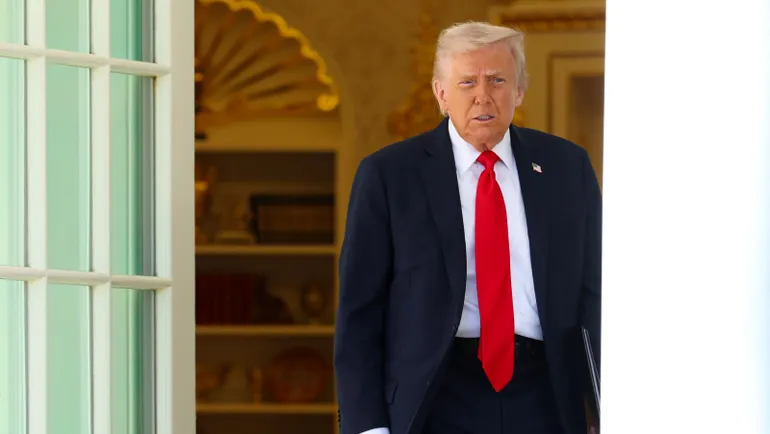


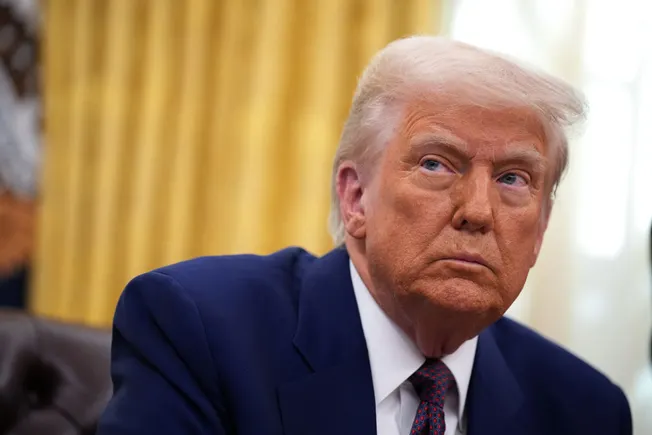
President Donald Trump signed an executive order Thursday challenging the growing ecosystem of state AI laws and setting the stage for a federal policy to oversee the technology, citing concerns over compliance challenges for businesses and stymying innovation.
The executive order tasks U.S. Attorney General Pam Bondi with creating an AI Litigation Task Force in the next 30 days to challenge state AI laws that “unconstitutionally regulate interstate commerce” or clash with existing federal laws. Trump also called for a national policy framework for AI that would preempt state AI laws, add child safety protections, ensure copyright safeguards and hinder censorship.
“My administration must act with the Congress to ensure that there is a minimally burdensome national standard – not 50 discordant State ones,” the order said. “The resulting framework must forbid State laws that conflict with the policy set forth in this order.”
States will face evaluation of their AI laws under the executive order, as well as potential restrictions on funding if their laws are found to be burdensome, according to the document.
The proposal was met with sharp criticism from some advocates and lawmakers including Sen. Amy Klobuchar (D-Minn.), who described the executive order as “dangerous, and most likely illegal,” in a post on social media platform X.
“Trump’s new executive order tries to eliminate state AI laws – in both red and blue states – that are protecting Americans from harmful deepfakes, scams, and online exploitation,” Klobuchar said on X. “We shouldn’t remove the few protections Americans have as Congress fails to act.”
Trump’s move to create roadblocks for state AI law implementation aligns with the interests of tech companies, which have worked against state regulations in 2025 as new models, agentic tools and applications spread among enterprises.
Despite its attempt to slow state efforts regulating AI, the executive order isn’t likely to shift enterprise compliance or AI governance strategies as a result, said Forrester Principal Analyst Alla Valente.
“They can’t pull back on what they’re doing when it comes to AI standards, assessments, controls and governance,” Valente said. “They’re going to have to stay the course on it.”
Companies building AI products, particularly in highly regulated fields such as healthcare, are aware they can’t adopt a technology without managing risk, said Alaap Shah, an AI, privacy, cybersecurity and health IT attorney at Epstein Becker Green. Many companies that have already adopted compliance frameworks based on consensus-based standards will likely continue to implement them, he added.
Still, businesses will continue to advance AI development and deployment regardless of the state of the regulatory landscape, Shah said.
“It’s sort of like a build now, fail fast mentality and investors are continuing to invest,” Shah said.
The pushback against state AI regulation comes at a time when tech companies like Google, OpenAI, AWS, Microsoft, Meta and more are investing billions in building out infrastructure in the U.S. and globally. Gartner estimated that global AI spending will reach $1.5 trillion in 2025.
Google and OpenAI earlier this year advocated for a federal policy preempting state AI laws. Meta also launched a lobbying effort to support political candidates who aligned with the company’s views on AI oversight, marking another step by Big Tech against state AI regulation after a proposed 10-year moratorium on state AI laws failed to pass in Trump’s One Big Beautiful Bill Act.
What CIOs can expect from U.S. states
As the AI market rapidly expands, U.S. states including California, Colorado, Connecticut and Texas have passed AI legislation in an attempt to regulate AI model developers and deployers. California’s AI law requirements stand to have a particular effect on CIOs and businesses because the law imposes direct obligations on companies that run data centers or are building their own AI models.
Navigating the landscape of state AI laws can be challenging for businesses because it requires them to comply with differing standards, which makes compliance tricky, Shah said. Even as enterprises create AI guidelines and policies, more than two-thirds of C-suite executives admitted to using unapproved AI tools, according to research commissioned by software company Nitro.
Many states are trying to solve similar issues with respect to AI, such as transparency, bias and discrimination risk, Shah said. That means states aren’t necessarily legislating in different directions but it can take time for businesses to understand the laws’ nuances.
“Clients who are developing AI or adopting AI certainly are attuned to the fact that there’s a litany of different kinds of AI laws out there and they’re variable across the states, many of which are nascent or maybe not even on the books yet,” Shah said. “There’s a great deal of ‘what do we need to focus on?’”
Businesses can struggle to keep track of what’s happening at the state level and understanding how it applies to their uses of AI, as well as developing AI-related compliance programs, said Katy Milner, a partner at law firm Hogan Lovells.
There are various roles within the AI value chain, from AI developers to deployers. While some legal frameworks apply exclusively to developers, others – like California’s AI law – can apply to both, Milner said.
“There are questions of when would a deployer be considered a developer because of the way they’re adapting it,” Milner said. “Developing compliance strategies amid this very active legislative backdrop has been challenging.”
Part of Trump’s policy push will be to target certain AI laws and make an example of ones the administration deems most burdensome, like Colorado’s, Shah said. Trump named the Colorado AI Act specifically in his executive order, which likely makes it first on the list to face the AI Litigation Task Force, he added.
New York and New Jersey state attorneys general have already indicated they plan to stand against the president’s order threatening U.S. states’ ability to regulate AI.
“We embrace technological innovation,” New Jersey State Attorney General Matthew Platkin said during a Thursday press briefing by The Leadership Conference on Civil and Human Rights. “But no industry in the history of our country has received the types of protections that these AI oligarchs are seeking and that apparently President Trump is willing to succumb to.”
Florida Governor Ron DeSantis also pushed back on executive authority to preempt state AI laws. He said Congress, after it didn’t vote to pass the 10-year state AI law moratorium, might not even want to pursue legislation preempting state AI laws. An attempt to include a state AI law preemption in the National Defense Authorization Act this year also failed.
“I doubt Congress has the votes to pass this because it is so unpopular with the public,” DeSantis said in a post on social media platform X.
Trump likely recognizes that passing a federal AI policy framework through Congress won’t happen anytime soon, Valente said. The order said the administration will be working on a “legislative recommendation” for Congress to establish a federal policy preempting state AI laws, but with no set deadline.
“This executive order is putting states on notice, hoping that it slows down some states from creating AI laws,” Valente said.