


Human Resources (HR) has always struggled with two identities. Is HR a strategic partner, a driver of organizational value and inspired human capital growth? Or is it an administrative function, acting as the “company police,” here to enforce rules, policies, legal, and labor regulations?
The first is a value creator and demands human skills; the second is an administrative function, which should be automated as much as possible.
This dual role has defined the profession for years. In fact there is a meme out there called “Don’t Trust HR,” which tried to convince employees that HR was the bad guys.
Well we are now entering a transformational time. Starting in 2026, the HR profession is undergoing a massive, AI-driven reinvention that will resolve this conflict, moving HR away from administrative overhead and toward a truly strategic, “full-stack” model.
The Weight of History: A Profession Growing in Complexity
The HR profession is vast, employing more than 40 million people globally and featuring hundreds of distinct job titles. Over the last 50 years the complexity of HR has exploded.
 |
Every time new business ideas, social norms, and legal requirements emerge, HR is asked to do new things. It started with basic payroll, hiring, and work administration and then evolved into training, industrial psychology, and job design. In the 1960s and 70s we added support for industrial psychology, career management, forced ranking, and 9-box based succession management.
In the last decades we added wellbeing, hybrid work, DEI (or death of DEI), productivity management, culture, management spans and leadership. And now, in the advent of AI, we must deal with ideas like talent density, flexible job and org design, “jobless” work, and vastly different models of pay equity and performance management.
How do we manage a company of Superworkers, for example, where a single individual can build apps, analyze data, and possibly influence business processes in a massive way? Will we all have Elon Musk-type employees who demand trillion dollar pay packages?
As new disciplines emerge, the old ones don’t go away, so HR winds up with dozens of specialists, each owning one of these 100+ domains.
Let’s now add the complexity of operating structure.
Bigger organizations use a federated HR model, with a central team and local teams for geographic regions or business units. These teams are often led by HR Business Partners—a role that can range from highly strategic to purely bureaucratic—and must localize policies to meet specific regional needs. So not only does HR needs processes and expertise, it must be delivered through local rules, job markets, and culture. (Hiring an engineer in Singapore is wildly different than hiring an engineer in Germany.)
The primary tool used to manage this complexity over the last two decades has been HR technology, specifically Human Capital Management (HCM) systems from vendors like Workday, Oracle, and SAP. While these systems are very sophisticated, they have largely functioned as “business workflow and record-keeping systems” rather than true solutions to human problems. They track employee data, manage payroll, and facilitate basic processes, but they still require an army of HR professionals to tune, administer, and manage them.
The AI Catalyst: From Record-Keeping to Agentic Action
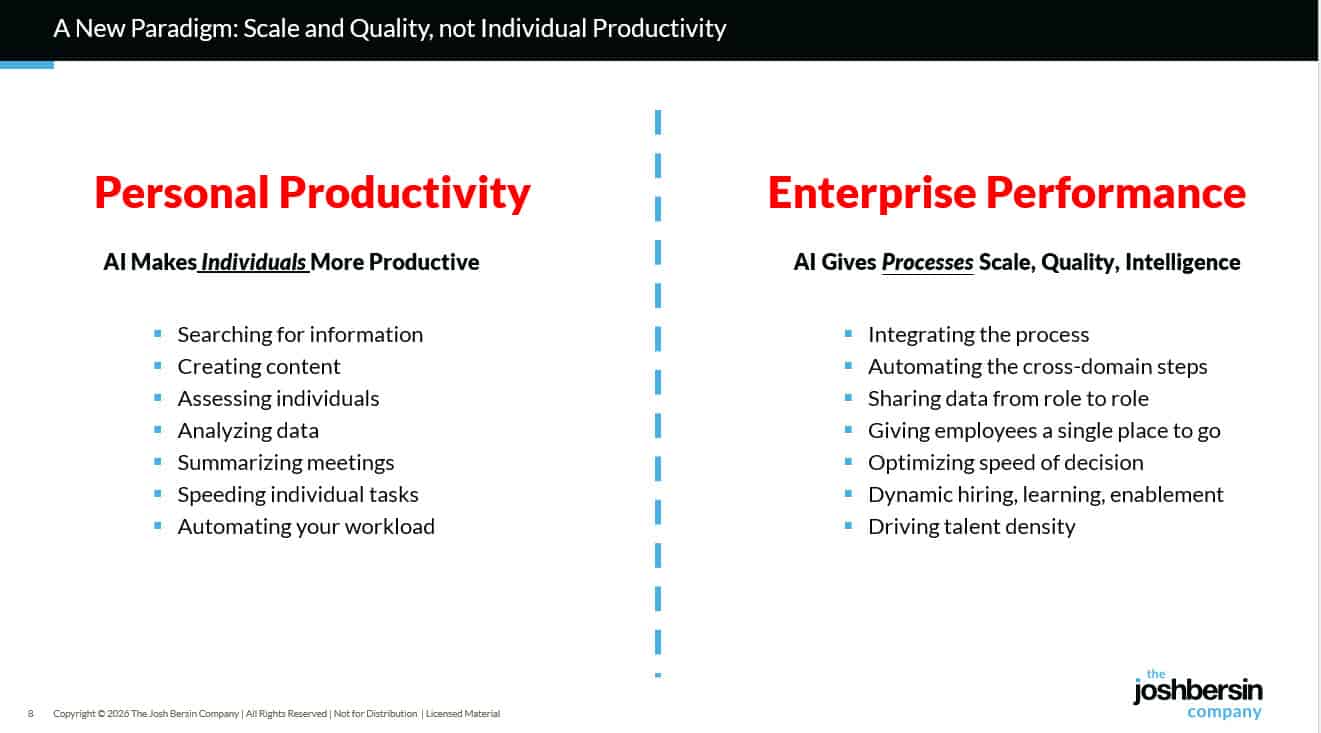
2026 marks a turning point, driven by enterprise AI. Rather than think of AI as a tool to increase individual productivity, we apply it to business processes themselves.
This takes us beyond the promise of increasing individual productivity: we redesign how the company operates and build what we call Superagents to create scale and autonomy.
 |
The best analogy is the autonomous car.
Rather than adding more and more features to make the driver more productive (power steering, brakes, lane collision detection, automatic parking) we collect these independent agents in a Superagent that focuses on the outcome, not the driver.
The purpose of a car is to optimize the mobility of the passengers, not to make the driver’s work easier. Suddenly the driver “goes away” (similar to replacing a routine job) and the car is 100-times safer. And whole new business models and scaling factors emerge (ie. not owning a car, but paying by the mile).
In HR and other business functions the same thing takes place. We started with assistants, then moved to agents (automation tools for individuals), and now move to Superagents to manage an entire process. This won’t happen overnight, but it’s now happening fast.
 |
We are already working with a large insurance company, an airline, and a pharma company on Superagents for global onboarding, targeted talent acquisition, and sales training. These agentic applications replace many HR jobs and wind up giving the company more scale and better results.
Why 30-40% of HR Jobs Will Go Away
Galileo, our AI agent for HR, has detailed task-level data for more than 250 jobs in HR. By querying Galileo, which also has detailed knowledge about automation tools and vendors, we’ve discovered that 30-40% of existing HR “jobs” can be automated with relatively low effort. (Users of Galileo can easily run these queries based on your own company’s HR job titles and org structure.)
These jobs, like “interview scheduler” or “recruitment coordinator” or “helpdesk assistant” make up the tactical, administrative work that bogs HR down. People in these roles can now take new responsibilities to build and manage AI agents, work with candidates, or consult with teams in the business.
Will the HR profession shrink? I actually think not. In the last five years HR job postings have increased by 60%, faster than most other professions. What’s going to change is the mix, and as I discuss in my recent podcast. We’ll see routine HR jobs go away, new AI roles created, and most HR professionals will become more “full-stack” in their roles. (I also think HR wages will go up, which I explain in the podcast.)
Areas Primed for Automation:
Through our Systemic HR AI Blueprint we’ve analyzed the top areas of opportunity. They typically fall into six areas:
- Talent acquisition and onboarding: AI agents can handle candidate screening, interview scheduling, and the complex, multi-step processes of bringing a new employee into the company. (I’ll write about bias and lawsuits more soon.)
- Employee Services: answering questions about policies, rules, regulations, and exceptions – replacing call centers with highly intelligent agents.
- Processing forms, claims, and records. The “back-office” work of maintaining accurate employee records and ensuring legal compliance, including administering LMS’s, is going to be automated.
- Training, employee enablement, and content delivery: With hundreds of billions spent on corporate training, AI can streamline the creation and delivery of personalized learning content. (Read our Revolution in Corporate Learning research for a discussion on the reinvention of this $400 billion market.)
- Increasing impact of HR Business Partners: offering agents like Galileo for Managers to offload business partners and let employees directly access advice, information, and tools to manage teams.
The Rise of “Full-Stack” HR
The ultimate goal of this automation is not cost reduction, but business value. By automating these processes we can make them more scalable, accurate, and easy on employees and managers. HR teams can help hire faster and more strategically; we can avoid the “hire/fire” cycles we’ve seen lately; we can train managers and workers in real time; and we can identify management problems, high turnover areas, and risks in a fast and predictable way.
For HR teams, professionals are freed to focus on what we call “Full-Stack HR“— strategic work that directly impacts the business’s bottom line.
This shift moves HR closer to the business units it serves. Instead of spending their time on data entry or policy enforcement, HR business teams can focus on:
- Talent acquisition and internal mobility: serving as talent advisor to decide who to hire, who to move, who to promote.
- Strategic Talent Management: Identifying high-potential leaders and developing career pathways that align with business and employee goals
- Culture and Engagement: Building a culture of safety, innovation, and high performance.
- Organization and Job Design: Helping the company adapt its structure and new job roles to adapt to AI and new market needs.
- AI Orchestration: A new and vital role involves building, stitching together, and architecting the AI agents that are automate HR processes.
The Impact on HR Benchmarks
A key metric in HR has long been the ratio of employees to HR staff. Historically, the benchmark has been around 100:1.
As AI takes over tactical work, we believe this ratio will shift significantly, potentially reaching 200:1, 300:1, or even 400:1.
While this implies fewer people are needed for administrative work, it may not shrink the size of HR much (many new jobs will be created). And this gets to the point of value: as more of AI becomes automated, HR salaries may go up. Consider the new opportunities:
A retail or food service company that uses AI to hire and schedule staff faster can directly increase revenue by meeting customer demand more quickly. (Chipotle has proven this.)
Manufacturing companies like Boeing can increase plane production through faster training, a stronger culture of safety, and more agile talent mobility. (We’ve talked with them about this.)
You get the drift.
A New Challenge: Data Quality and Trust
One more thing to consider.
As HR moves at the speed of AI, the importance of accuracy, explainability, and trust becomes paramount. In a manual system a human recruiter might make an occasional error. In an automated system operating at scale, a single error in a recruiting algorithm or payroll rule could affect thousands of employees instantly.
Many of he new HR roles involve managing the quality and integrity of these systems. HR professionals must ensure that the AI agents they deploy are fueled by data which is accurate, up to date, and complete.
And HR now owns the problem of AI bias and trust. Two lawsuits against HR vendors (Workday and Eightfold) show how important it is to build explainable, high trust systems. This now falls on HR’s plate. (More on AI data quality to come.)
Embrace the Transformation
This is all happening now. If you’re an HR professional or HR leader, it’s time to dig in (Galileo will teach you). Call us if you’d like any help with your HR transformation and listen to my latest webcast on the 11 Imperatives for HR in this new world of Enterprise AI. (Check out our Galileo AI-driven certificate program on Enterprise AI in HR.)
Additional Information
Imperatives for 2026: What’s Ahead for Enterprise AI, HR, Jobs, And Organizations
The Collapse And Rebirth Of Online Learning And Professional Development
Yes, AI Is Really Impacting The Job Market. Here’s What To Do.
Get Galileo: The World’s AI Agent For Everything HR and Leadership