

Remember the days when working hours were recorded with pen and paper? Today, time is your most valuable resource and now, more than ever, businesses are automating their tedious, manual admin work. They’re utilizing automation tools to boost productivity and simplify their workload. The best time tracking apps take this manual work off your plate, especially in countries like Germany, where time tracking laws are strict. That’s why we’ve compiled a list of the top 10 best time tracking apps in Germany so you can stay compliant while enhancing your admin workflows. We compare the best options for you and show how you can save time, reduce costs, and stay compliant. 👇🏻⏰
Time Tracking Laws in Germany
Time tracking is mandatory in Germany, making it essential that employers understand their responsibilities and how to stay compliant with labor regulations. Since the Federal Labor Court (BAG) decision in 2022 (1 ABR 22/21), employers in Germany must introduce a system to record total working time (§ 3 para. 2 no. 1 ArbSchG). The legal framework is based on the German Working Hours Act (Arbeitszeitgesetz, ArbZG). Back in 2019, the European Court of Justice (ECJ) already required an “objective, reliable and accessible” system to measure daily working time (Case C‑55/18 “CCOO”).
📌 Are you in a rush? Click here to see our top 10 best time tracking apps in Germany at a glance!
To implement (and simplify) the upcoming digital time tracking process, an accessible and user-friendly app can make all the difference.
So why is a time tracking app worth it?
Compliance made easier
A time tracking app simplifies recording working hours for all employees and enables self-service. For the business, recorded working time means you can respond effectively to any labor inspection and demonstrate compliance.
Flexibility for mobile and hybrid teams
In addition to a desktop solution, employees can record working time flexibly via their mobile device. That means compliant time tracking on the go — ideal for business trips, field service, or hybrid work.
Process automation
Digitizing time tracking reduces the time spent on manual tasks. With a time tracking app, employers can monitor productivity in real time. And it gets better: HR processes like absences, break times, and shift planning become easier to manage, too. The result is a more efficient organization and better planning.
Transparency and security
A time tracking app allows both sides to view detailed time records. Compared to traditional clocking systems, digital tools provide both employers and employees with greater control over access to information.
Integrations with other tools
Most time tracking apps integrate easily with payroll and HR systems, helping you avoid duplicate data entry.
| App | Key features | Key integrations | Starting price | Rating | Best for |
|---|---|---|---|---|---|
| Factorial | Mobile time tracking with GPS/QR, shift planning, absences, approvals & expenses — all in one app | DATEV, Slack, Google Workspace, MS Teams | €8 (*$9.30) / user / month | ⭐⭐⭐⭐⭐ | Companies looking for an all-in-one solution for time, HR & finance |
| Clockify | Mobile timer, punch clock/kiosk, GPS (only on higher plans) | Jira, Trello, Asana, Zapier | Free / from $3.99 (*$4.65) | ⭐⭐⭐⭐ | Freelancers & small teams who want to start for free |
| TimeTac | App with GPS, geofencing, NFC, project time & absences | Jira, MS Teams, SAP | €17.50 (*$20.40) + modules | ⭐⭐⭐⭐ | Mid-size & large companies with field service or construction |
| factro | Project management app with built-in time tracking | MS Teams, Outlook, Zapier | €7.99 (*$9.30) / user | ⭐⭐⭐ | Teams strongly focused on project control |
| Toggl Track | Simple project time tracking, strong reports, no GPS | Asana, Slack, Notion, Zapier | $9 (*$10.50) / user | ⭐⭐⭐⭐ | Agencies, consultancies & remote teams |
| clockin | Mobile time tracking + iPad terminal/QR/PIN, travel time | DATEV, Lexoffice, sevDesk | €3.99 (*$4.65)/ user | ⭐⭐⭐⭐ | Trades, logistics & service teams |
| Clockodo | Work & project time tracking, absences, analytics | DATEV, Lexoffice, Zapier | €5 (*$5.80)/ user | ⭐⭐⭐⭐ | Freelancers, consultants & SMBs |
| Papershift | Shift planning + mobile time tracking, no GPS | DATEV, Personio, Zapier | €6–€9 (*$7-10.50)/ user + €39 (*$45.50) base fee | ⭐⭐⭐ | Hospitality, retail, healthcare |
| Shiftbase | Shift planning + mobile time tracking with GPS restriction | Exact, AFAS, API | €3.25 (*$3.80)/ user | ⭐⭐⭐⭐ | SMBs with shift work & field teams |
| Planerio | Healthcare app: shifts, time tracking, collective agreement rules | Hospital interfaces, DATEV | from €2.90 (*$3.40) / user (estimate) | ⭐⭐⭐⭐ | Hospitals, care homes & medical practices |
*Prices are subject to change – please reach out to the company directly for any inquiries about pricing.
When selecting a time tracking app, it’s crucial to focus on the features that match your company’s needs. It depends on what your organization requires: basic time tracking only — or also shift planning, project time, and clear break rules. It’s particularly vital that the time tracking app you chose is compliant with German labor regulations and prevents your business from accuring any penalities.
Just as important: employee adoption. An intuitive app with fast clock-ins, easy shift swaps, and self-service is more likely to be adopted across the workforce. Check user reviews and ratings (e.g., Google Play Store/Google Reviews) for real-world feedback on usability, stability, and support quality – this way you can find the most reliable time tracking app in Germany.
Below are some of the best apps on the market:
1. Factorial
Factorial is an all-in-one HR app that provides a comprehensive solution for managing your company’s resources. It stands out for its usability — it’s a highly intuitive app with a built-in AI agent, One, and a robust time and attendance software. Moreover, Factorial has a dedicated German-speaking team to show you the platform, onboard your team, and troubleshoot any platform issues you may be experiencing. This makes Factorial an ideal solution due to it’s compatibility with different languages, multiple currencies, and ability to streamline communication with global teams.
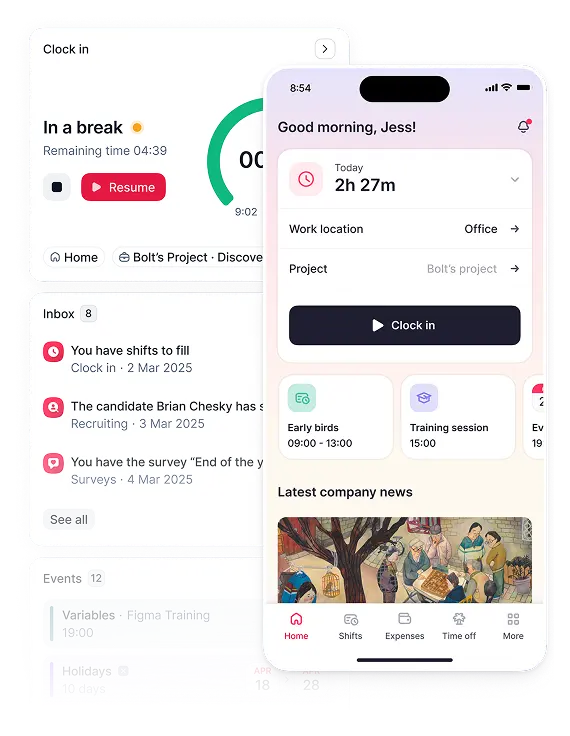
Employees can clock in and out via the Clock In area — whether working from home, on the go, or on-site. Deviations from the defined standard working time are visible immediately. You can even set custom notifications for both the employee and manager to resolve any time anomolies. Additionally, if an employee forgets to clock in, they’re automatically notified – ensuring accurate timekeeping records. Factorial’s time tracking app includes biometric features, ability to clock-in on a mobile device or desktop, and offline time tracking.
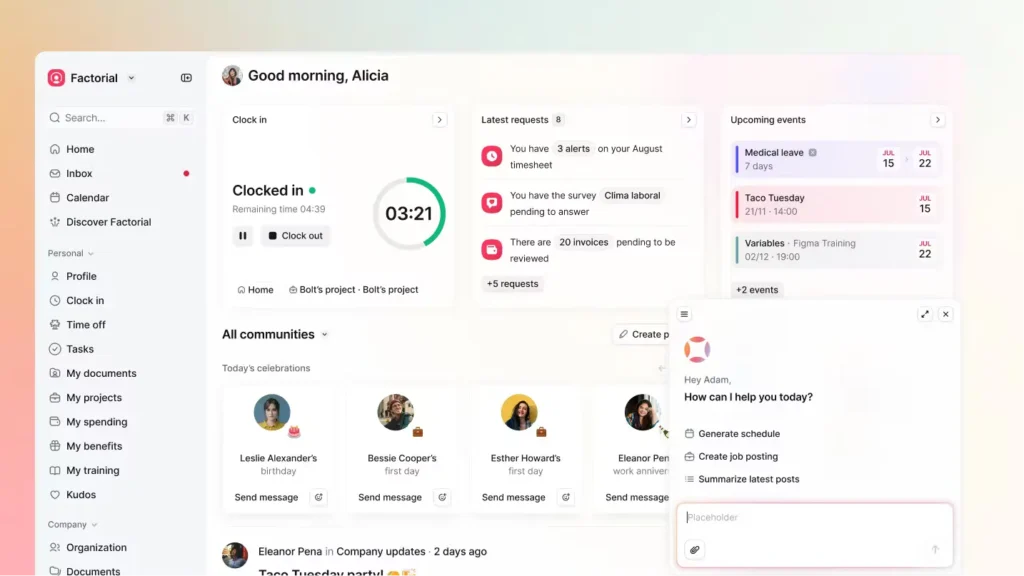
What makes Factorial different: Factorial is an all-in-one platform that offers more than time tracking. You receive other HR functions to automate all aspects of your business from expense management, talent acquisition, to even IT asset management. Factorial eliminates the need to juggle between multiple platforms as you’ll be able to manage all your core processes from one centralized solution. It’ll be easy to access timekeeping records, sync employee hours to payroll, and grant employees company cards for their business trips.
Additional examples are:
-
Shift planning: Build the ideal schedule with automated shift planning and approve swap requests in one click. Changes are reflected in real time and employees are notified — no chaos, no surprises.
-
Absences: Teams can request absences from their managers and get a clearer overview of vacation and sick days.
-
Project time tracking: Track and analyze hours by project, task, or cost center. Especially helpful for service providers, agencies, and companies in construction and production.
-
Pre-payroll preparation: Payroll and the DATEV integration support smooth salary processing, including individual expenses and supplements. Thanks to the two-way interface with DATEV, data exchange is secure and efficient. Factorial is a DATEV marketplace interface partner.
2. Clockify
If your company is a startup, this time tracking app could be interesting to use with your German team. It’s aimed at small companies and offers a free basic plan so you can track employee hours without an upfront investment.
The app shines for its simplicity in core time tracking (project time and reporting). But for companies with growth plans, this is often not enough: advanced features like absences, shift and duty scheduling, payroll exports, audit logs, API integrations, and advanced reporting sit behind paid add-ons and remain time-tracking-centered. The result is running parallel solutions for payroll, HR admin, and communication. All-in-one platforms like Factorial bring these areas together in a single system and scale without tool fragmentation.
3. TimeTac
TimeTac is a comprehensive enterprise-grade app for time and absence management. It includes geolocation, geofencing, and NFC time tracking — making it ideal for industries with employees in the field, such as construction or healthcare.
Beyond basic time tracking, the app supports project hours, absences, and compliant reports, helping ensure accuracy in complex organizations. Its modular structure allows companies to tailor the solution to their needs. TimeTac’s extensive platform is what makes it one of the best time tracking apps in Germany.
Downsides are cost and complexity: while reliable, it can feel overwhelming for smaller companies that only need a lightweight solution. Total costs can also rise quickly as teams grow, due to per-user pricing and paid add-on modules.
4. factro
factro is primarily a project management app with built-in time tracking. Teams can log hours directly to tasks, track progress, and link work logs to projects — making it a fit for project-driven organizations. Its key strength is combining planning and execution: managers can assign tasks, set deadlines, and measure the actual time spent.
However, factro is less suitable for companies looking for standalone time tracking or attendance features, because it prioritizes project control over HR or payroll capabilities.
5. Toggl Track
Toggl Track is one of the most user-friendly apps for freelancers and agencies, known for straightforward design and strong reporting. Employees can log time in one click, assign time to projects, and export professional reports.
The mobile app is lightweight and integrates well with productivity tools like Asana, Slack, and Notion. It focuses more on usability and insights than on deeper workforce control.
A key downside is the lack of native GPS or geofencing features — so it’s not ideal for teams that need location-based verification. There’s also no direct DATEV integration, which can complicate payroll workflows and data exchange. Additionally, Toggl Track is relatively less well-known in the German market, which can make onboarding and employee self-service discovery harder.
6. clockin
clockin focuses on time tracking and project documentation and is especially suited for field service, logistics, and retail. Employees track time via smartphone, iPad, or terminal — optionally with QR or PIN. It’s a popular choice for remote teams as well as on-site operations that need a comprehensive time tracking app in Germany.
Core functions include travel time tracking, project booking, and expense management. Integrations with DATEV and Lexoffice help connect payroll directly — a plus for DACH-region companies.
The focus is clearly on time tracking and service-oriented industries. Advanced HR functions like performance management or strategic workforce planning are not included. In OMR Reviews user feedback, some reviewers also criticize missing features such as flexible checklist/template customization, more advanced analytics options, or a simple vacation planner.
7. Clockodo
Clockodo is a flexible app designed for small and mid-sized companies and freelancers. It offers straightforward time and project tracking, plus vacation and absence management. Reports can be customized for billing and compliance.
The app is valued for transparency and simplicity and is GDPR-compliant. It also integrates with accounting tools like DATEV and Lexoffice.
The focus remains firmly on time tracking and service-oriented industries. Advanced HR functions like performance management or strategic workforce planning are not part of the offering. In Trustpilot reviews, some users occasionally note that the desktop version can feel slow with more complex configurations and that navigation becomes less clear. Some setups require support assistance.
8. Papershift
Papershift focuses on shift planning and attendance. Employees can clock in/out via smartphone, request shifts, and managers can organize schedules.
Because it’s well known in hospitality and retail, Papershift intentionally avoids GPS tracking and prefers on-site check-in methods (PIN code, signature, or terminals).
This makes Papershift a solid option for companies with predictable shifts, but less attractive for mobile teams that need location-based controls.
9. Shiftbase
Shiftbase is a shift and time management application focused on accessibility and cost efficiency. Its mobile app lets employees clock in, request vacation, and view schedules. A GPS restriction ensures check-ins only happen at authorized locations.
Its pricing model appeals to small and mid-sized businesses, and it scales well for distributed teams.
However, feature depth is limited compared to all-in-one HR platforms. Some users miss certain planning/printing options and more flexible reporting. For companies that need deeper HR integration, it’s only partially suitable.
10. Planerio
Planerio specializes in healthcare organizations, especially clinics, hospitals, and care homes. Employees can clock in/out, manage shifts, and apply complex working rules (such as night or weekend premiums).
The app automates large parts of scheduling in environments with demanding compliance requirements. The mobile interface makes it easy for healthcare staff to view shifts and log hours.
That said, Planerio is less relevant outside the healthcare sector, because its strengths are built around specialized compliance rather than general workforce management.
When choosing the best time tracking app in Germany, consider key factors such as company size, budget, and useability. Some apps fit SMBs better, while others are built for large organizations with more complex needs.
💡 Important: The best time tracking app is the one that meets your team’s requirements. That’s why it’s critical to evaluate the features your business needs and what each app can provide.
Another factor is your operational reality. For example, if your workforce is hybrid or mobile, you’ll likely need geolocation or location restrictions. If you need features beyond basic time tracking, an all-in-one solution like Factorial is the better option — because you get all your tools in one platform.
As we’ve discussed throughout this blog, it makes the most sense to choose a mobile app — or at minimum an HR platform that fits today’s remote-work context. With its all-in-one solution, Factorial offers both options to boost your team while reducing admin workload. Explore all of Factorial’s features by speaking with an HR consultant, you can even ask for a free 7 day trial to truly experience all that Factorial has to offer!
*Disclaimer:
The information presented on this page is based on publicly available sources. The comparisons between Factorial and other providers are intended solely for the illustration of the respective software features, pricing and functionalities. All information regarding features, prices, and integrations may be subject to change without prior notice. Factorial assumes no liability for the accuracy, completeness, or timeliness of the information presented. We recommend contacting the respective providers directly to obtain the most accurate and up-to-date information. All legal regulations regarding Spanish fair advertising and competition law are fully observed by us; if you have any concerns, please reach out to us. The comparisons presented do not constitute a final evaluation or recommendation for any provider, but serve solely as an informational source.