


As we step into 2026, one thing is clear: employer branding has entered a new era. What once lived primarily as a recruitment message now carries far greater weight. Today, an Employer Value Proposition (EVP) must operate as a human contract, guiding leadership decisions, shaping everyday employee experience, and standing up to real-time verification in a world of radical transparency.
For leaders seeking an employer brand strategy partner—not just a marketing agency, this shift requires rethinking EVP as a system that governs culture, leadership behavior, and performance in a world increasingly shaped by AI-powered talent decisions.
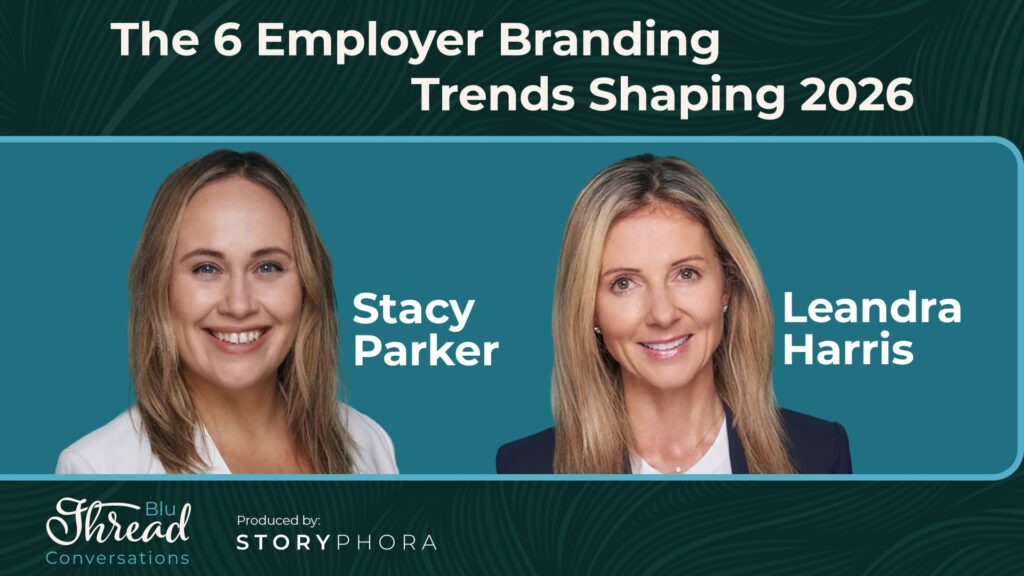
In this episode of Blu Thread Conversations, Blu Ivy Group founders and employer brand strategy advisors Leandra Harris and Stacy Parker reflect on the lessons of 2025 and unpack the six trends shaping employer branding and culture performance in 2026. Together, they explore what’s broken, what must evolve, and how leaders can use employer brand as a true driver of business performance.
Who This Trends Insight Is For
If you are a CHRO, COO or senior leader trying to make employer brand credible in a year of radical transparency, this is for you — especially if:
- Your EVP still lives mostly in recruitment marketing, not in leadership decisions or employee experience.
- You’re navigating change (growth, restructuring, M&A, transformation) and need culture stability and trust.
- You want a clear, measurable employer brand strategy, not just content, recruitment campaigns, or messaging.
- You’re seeing disconnects between what you say externally and what employees experience internally.
- You need an EVP that can stand up to real-time verification (reviews, social, AI search) and still build confidence.
At Blu Ivy Group, we build EVP as a human contract, so your employer brand becomes the governing logic for culture and performance, and the foundation that allows AI-powered recruitment, onboarding, talent management, and leadership communications to operate with clarity, consistency, and credibility.
➣ Listen to the full episode on YouTube
A Wake-Up Call for Employer Branding
Before looking ahead, Leandra and Stacy pause to name what many leaders quietly felt throughout 2025: the industry hit a reckoning. Despite years of advocating for employer brand, many organizations still struggle to connect EVP to the realities of culture, leadership, and performance.
The problem isn’t a lack of belief; it is a misunderstanding of what an employer brand is meant to do.
Too often, EVP is treated as:
- A talent marketing campaign
- A set of polished values statements
- A recruitment message designed to fix reputation challenges.
Employer brand was never meant to live only at the front door. When EVP is disconnected from experience, retention suffers, trust erodes, and reputation becomes fragile.
At Blu Ivy Group, we view the employer brand differently: as a governance system for culture and performance, one that aligns beliefs, behavior, experience, and outcomes.
The Myths Holding Organizations Back
Throughout the conversation, Leandra and Stacy call out the most persistent myths limiting employer brand impact:
Myth 1: EVP is a Recruitment Marketing Message
An EVP that only exists externally does nothing to retain, engage, or mobilize talent. EVP must anchor leadership decisions and clarify the reciprocal commitment between the organization and employee.
Myth 2: Authenticity
Listening to employees matters, but authenticity is proven when EVP actively governs decisions, behaviors, and recognition. If employees don’t feel it, it isn’t real.
Myth 3: Differentiation
True differentiation does not come from clever taglines—it comes from the programs, leadership behaviors, and investments an organization chooses to double down on.
Myth 4: Employer brand is Just Talent Communications
Employer brand must be experienced, not just communicated. Culture lives in how work gets done.
Myth 5: One global EVP fits all regions
Strong employer brands allow for regional adaptation while staying rooted in a shared human contract.
Why Employer Brand Strategy Must Expand Beyond Campaigns—Without Leaving Talent Behind
Employer brand has long lived within talent acquisition, recruitment marketing, and communications—and for good reason. EVP plays a critical role in attracting the right talent with the values, motivations, and expectations that fuel strong cultures.
But in 2026, that role must expand.
In a world shaped by AI-powered talent systems, radical transparency, and constant change, employer brand strategy must do more than attract attention. It must generate momentum. Connecting talent, leadership, culture, and reputation into a shared system.
Traditional employer brand approaches often focus on:
- Using EVP primarily as a talent attraction and messaging tool
- Measuring success through awareness, engagement, or applicant volume
- Activating EVP most visibly through recruitment and employer marketing channels
- Expecting messaging to compensate for gaps in leadership alignment or management capability
Blu Ivy’s employer brand strategy and performance tracking is designed to:
- Strengthen talent attraction by clearly signaling the values, behaviors, and mindsets the organization is committed to—and expects in return.
- Equip managers and leaders with a shared human contract that enables reciprocal, credible communication about culture, performance, and business goals.
- Create consistency and alignment across leadership messaging, employee experience, and AI-powered recruitment, onboarding, and talent management systems.
- Connect employer brand to broader reputation outcomes—preferred employer status, leadership credibility, and stronger customer experiences.
When EVP operates as strategy, not just messaging—it gives energy to culture, clarity to leadership, and confidence to the market.
Six Employer Brand Trends Shaping 2026
1. Inside-Out Branding: Living the EVP
In 2026, the strongest employer brands will launch internally first. Leaders are increasingly using EVP as a management system, embedding it into onboarding, performance management, leadership development, and recognition.
The shift is clear: employees must experience and validate the EVP before it’s amplified externally.
2. Radical Transparency
With real-time reviews, AI-powered search, and social platforms shaping perception, organizations can no longer curate reputation through campaigns alone.
Employees and candidates expect clarity around:
- Pay and career progression.
- Leadership development
- DEI and belonging
- Benefits and performance expectations
Transparency isn’t about oversharing; it’s about credibility.
3. The Rise of the “Social CEO.”
People do not just join companies, they join leaders.
In 2026, CEO and executive visibility around culture will be a defining differentiator. Leaders who consistently talk about people, experience, and values build trust long before a crisis hits.
Research and lived experience continue to show a strong correlation between:
- CEO cultural visibility
- Employer reputation
- Review scores and talent confidence
4. Employee Advocacy as Co-Creation
Employee advocacy is not new, but in 2026, it evolves beyond scripted brand ambassadorship.
Organizations that win will:
- Equip employees with EVP-aligned frameworks
- Trust them with creative freedom
- Treat advocacy as a partnership, not control
Authenticity comes from letting real voices lead.
5. Crisis-Proofing Through EVP
Change, restructuring, leadership transitions, and market pressures are inevitable. What differentiates resilient organizations is whether employees understand:
What does this change mean for me, and what is the organization’s commitment to me through it?
EVP acts as a stabilizing force when uncertainty rises, reinforcing psychological safety and trust.
6. Measuring the Impact
In 2026, employer brand leaders will be held accountable not just for content engagement, but for business outcomes.
The most credible measurement frameworks track:
- Leadership alignment – Are leaders living the EVP?
- Employee experience – Do employees believe it?
- Reputation and preference – Are candidates, customers, and markets choosing you?
Employer brand, when done well, contributes directly to growth, performance, and market confidence.
From Messaging to Meaning
As Stacy Parker summarizes:
“Your EVP is not a campaign. It’s a human contract.”
In 2026, culture is no longer about what organizations ask of people; it’s about how leaders and employees move forward together.
Employer Brand Strategy FAQs
Why isn’t our EVP or employer brand working?
Because it’s only being seen by one audience.
Many organizations invest in strong employer messaging that job seekers understand—but employees and managers never truly see, feel, or use it. It’s the equivalent of building a compelling company brand that only customers recognize, while the people inside the organization don’t know what makes it distinctive or how to deliver on it.
When EVP lives only in recruitment campaigns, it creates distance instead of alignment. Candidates arrive with expectations the organization has not operationalized. Managers lack a shared language to lead with. Employees struggle to explain what truly differentiates their workplace—because it was never designed for them in the first place.
When employer brand becomes shared understanding, not just external messaging, it starts to work.
What does employer brand do for a business—if we already have a culture or engagement strategy?
Engagement strategies focus on how people feel at work. Employer brand shapes how people understand their relationship with the organization.
Most engagement strategies are designed to improve motivation, morale, or participation—often through programs, surveys, or initiatives. They are valuable, but they tend to operate within an existing system of expectations.
Employer brand works at a different level. It clarifies the underlying human contract: why the organization exists, what it asks of people, and how individual effort is met day to day. When that contract is clear, engagement follows naturally. When it isn’t, engagement efforts often feel episodic, performative, or short-lived.
In other words, engagement can encourage people to try harder. Employer brand helps people decide whether they want to.
How does AI affect employer branding and EVP?
AI can accelerate decisions, but it cannot create clarity. Without a shared understanding of culture, expectations, and leadership priorities, AI systems simply scale inconsistency.
A strong EVP gives AI-powered recruitment, onboarding, and talent management platforms the human logic they need to reinforce—rather than distort—culture and performance. When EVP is clear, technology amplifies alignment instead of confusion.
Why do high-performing organizations invest in employer brand—even when they already have a strong purpose?
Because purpose alone is not enough. Many organizations articulate a compelling mission for the world—but fail to translate that mission into a lived, reciprocal experience for the people doing the work.
A strong employer brand makes purpose personal. It clarifies not just what the organization exists to do, but what that mission asks of individuals—and what this work gives back to the people who give so much of themselves. When people can see their own values, growth, and well-being reflected in the organization’s goals, culture becomes a source of momentum rather than obligation.
That is what sustains performance, resilience, and long-term success. for the business and for individuals.
Listen, Watch, and Continue Conversation
Blu Thread Conversations is recognized as a leading podcast on employer branding and culture performance, featuring candid conversations with global thought leaders.
➣ Watch the full episode on YouTube
If you’re navigating EVP, culture transformation, or employer brand strategy in 2026, we’d love to connect.
Leandra Harris and Stacy Parker are consistently recognized among the world’s most trusted voices in employer branding and culture consulting, helping organizations build credible, resilient, and high-performing cultures.
About Blu Ivy Group
Blu Ivy Group is a globally recognized employer brand and culture strategy consultancy, trusted by CEOs, CHROs, and leadership teams navigating growth, change, and complexity.
Our work starts where culture and engagement efforts fall short: not with messaging or programs, but with clarity. We help organizations define the human contract that sits beneath culture. Clarifying expectations, commitments, and the lived experience of work, so people can decide how fully they want to show up.
Unlike traditional employer brand or talent marketing agencies,
Blu Ivy focuses on what gives culture energy and credibility over time. We help organizations align employer brand, leadership behavior, employee experience, and reputation into a single, coherent system. One that supports performance, trust, and long-term resilience in a world shaped by AI, transparency, and constant change.
For more than a decade, Blu Ivy Group has partnered with organizations across healthcare, financial services, technology, and professional services throughout Canada, the United States, and globally. Our work helps leaders move beyond values on the wall and engagement initiatives that fade—toward cultures that people believe in, commit to, and sustain.
To learn more or connect with our advisory team, visit bluivygroup.com.