


By Kavita Dehalwar
Sustainable development and environmental planning are no longer confined to single disciplines or narrowly defined policy tools. Instead, they have evolved into deeply interconnected research domains that span urban planning, environmental health, solid waste management, climate resilience, artificial intelligence (AI), and sustainable construction technologies. Recent scholarship highlights how global environmental challenges—climate change, rapid urbanisation, resource depletion, and social vulnerability—are reshaping both research priorities and planning practices. Drawing on contemporary peer-reviewed literature, this blog post outlines some of the most prominent emerging research themes shaping the future of sustainability and environmental planning.
1. Nature-Based Solutions and Climate Resilience
One of the strongest emerging themes is the application of nature-based solutions (NbS) to address climate risks, particularly in vulnerable ecological regions such as river deltas and coastal settlements. Research increasingly emphasises ecosystem-based planning approaches—mangrove restoration, wetland conservation, floodplain management, and green-blue infrastructure—as cost-effective and socially inclusive alternatives to hard engineering solutions. Studies on deltaic regions in India demonstrate how NbS can simultaneously enhance climate resilience, biodiversity conservation, and livelihoods, making them central to sustainable regional planning frameworks. This research direction aligns strongly with SDG 11 (Sustainable Cities and Communities) and SDG 13 (Climate Action).
2. Environmental Health and Peri-Urban Waste Challenges
Another growing research focus concerns environmental health risks linked to solid waste management, especially in peri-urban and transitional zones. These areas often fall outside formal municipal service coverage, leading to unmanaged dumping, groundwater contamination, and public health vulnerabilities. Recent studies stress the need for integrated planning models that link waste infrastructure, land-use planning, and health risk assessment. This theme highlights a shift from purely technical waste solutions to more holistic, people-centred and health-sensitive planning approaches.
3. Artificial Intelligence for Sustainable Environmental Governance
The integration of artificial intelligence (AI) into environmental planning and management represents a rapidly expanding research frontier. AI tools are being explored for waste segregation, route optimisation, predictive maintenance of infrastructure, environmental monitoring, and decision-support systems. Beyond technical efficiency, emerging research also examines AI’s role in social domains—such as social work, governance, and community engagement—to promote environmental sustainability. This interdisciplinary theme raises critical questions around ethics, data governance, inclusivity, and the capacity of local institutions to adopt smart technologies responsibly.
4. Advanced Solid Waste Management Techniques
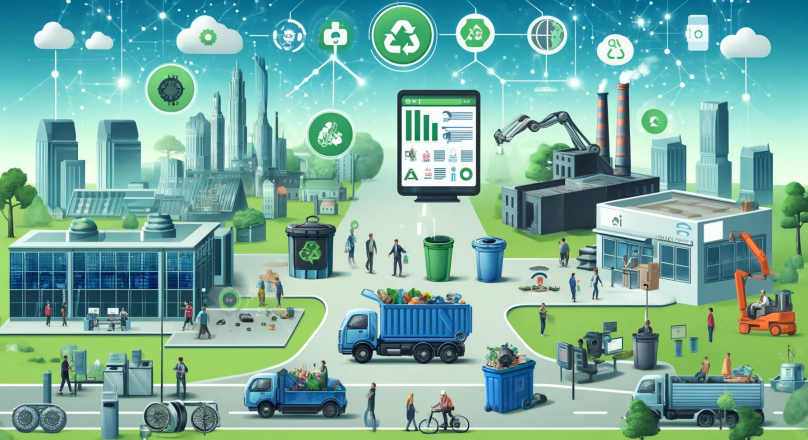
Solid waste management research has moved beyond conventional collection–transport–disposal models toward circular economy-oriented systems. Emerging studies focus on waste-to-energy technologies, material recovery, decentralised processing, and policy-driven innovations such as extended producer responsibility (EPR). Importantly, recent literature highlights the need to integrate these technologies within urban and regional planning frameworks, ensuring land availability, environmental safeguards, and social acceptance. This reflects a broader shift toward systems thinking in environmental planning research.
5. Sustainable Construction Materials and Life Cycle Assessment
In the built environment domain, a significant research trend centres on life cycle assessment (LCA) of construction materials and infrastructure. Studies evaluating recycled and secondary materials in road construction illustrate how embodied energy, emissions, and resource efficiency can be systematically assessed during planning and design stages. Parallel research on innovative materials—such as self-healing concrete, biocrete, and self-sensing concrete—signals a growing interest in durability, resilience, and long-term sustainability of infrastructure systems. These themes bridge environmental planning with materials science and civil engineering.
6. Green Buildings and Sustainable Neighbourhoods
The role of green buildings has expanded from energy-efficient structures to catalysts for sustainable neighbourhood development. Recent research highlights how building-scale interventions—energy efficiency, water conservation, passive design, and renewable integration—can generate cumulative benefits at the community level. This theme reinforces the importance of neighbourhood-scale planning, mixed land use, walkability, and public spaces in achieving environmental sustainability outcomes.
7. Prefabrication and Industrialised Construction
Prefabricated and modular construction has emerged as a promising pathway for sustainable urban development. Thematic analyses of prefabrication research reveal its potential to reduce construction waste, improve quality control, shorten project timelines, and lower environmental impacts. For planners and policymakers, this research underscores the need to adapt building regulations, zoning norms, and supply chains to support industrialised construction methods.
8. Climate, Migration, and Food Security Linkages
Finally, an increasingly important theme links climate disasters, migration, health risks, and food security, particularly in the Global South. Research in this area highlights how environmental stressors reshape settlement patterns, strain urban systems, and exacerbate vulnerability. This integrative perspective calls for planning approaches that are not only environmentally sustainable but also socially resilient and equity-driven.
Concluding Reflections
Collectively, these emerging research themes signal a profound transformation in sustainable development and environmental planning. The field is moving toward interdisciplinary, technology-enabled, and justice-oriented approaches that recognise the complex interdependencies between environment, society, and the built form. For researchers, practitioners, and policymakers, engaging with these themes is essential to designing resilient, inclusive, and sustainable futures in an era of overlapping global crises.
Dehalwar, K., & Sharma, S. N. (Eds.). (2026). Deltas resilience: Nature-based solutions for sustainable development in India. Springer Nature. https://link.springer.com/book/9783032072399
Kumar, G., Vyas, S., Sharma, S. N., & Dehalwar, K. (2024). Challenges of environmental health in waste management for peri-urban areas. In M. Nasr & A. Negm (Eds.), Solid waste management (pp. 149–168). Springer Nature Switzerland. https://doi.org/10.1007/978-3-031-60684-7_9
Lucero-Prisno, D. E. III, Ayuba, D., Akinga, A. Y., Olayinka, K. E., Precious, F. K., Ogaya, J. B., Sharma, S. N., … Kouwenhoven, M. B. N. (2025). Impact of climate disaster, migration and health risk on food security in Africa. In Advances in food security and sustainability. Elsevier. https://doi.org/10.1016/bs.af2s.2025.08.003
Ogbanga, M. M., Sharma, S. N., Pandey, A. K., & Singh, P. (2025). Artificial intelligence in social work to ensure environmental sustainability. In M. Nasr, A. Negm, & L. Peng (Eds.), Artificial intelligence applications for a sustainable environment (pp. 1–??). Springer. https://doi.org/10.1007/978-3-031-91199-6_16
Sharma, S. N., Dehalwar, K., & Singh, J. (2024). Emerging techniques in solid waste management for a sustainable and safe living environment. In M. Nasr & A. Negm (Eds.), Solid waste management (pp. 29–51). Springer Nature Switzerland. https://doi.org/10.1007/978-3-031-60684-7_3
Sharma, S. N., Dehalwar, K., Jain, S., & Pandey, A. K. (2025). An assessment of the applications and prospects of AI tools in solid waste management. In M. Nasr, A. Negm, & L. Peng (Eds.), Artificial intelligence applications for a sustainable environment. Springer. https://doi.org/10.1007/978-3-031-91199-6_4
Sharma, S. N., Lodhi, A. S., Dehalwar, K., & Jaiswal, A. (2024). Life cycle assessment of recycled and secondary materials in the construction of roads. IOP Conference Series: Earth and Environmental Science, 1326(1), 012102. https://doi.org/10.1088/1755-1315/1326/1/012102
Sharma, S. N., Prajapati, R., Jaiswal, A., & Dehalwar, K. (2024). A comparative study of the applications and prospects of self-healing concrete / biocrete and self-sensing concrete. IOP Conference Series: Earth and Environmental Science, 1326(1), 012090. https://doi.org/10.1088/1755-1315/1326/1/012090
Sharma, S. N., Singh, S., Kumar, G., Pandey, A. K., & Dehalwar, K. (2025). Role of green buildings in creating sustainable neighbourhoods. IOP Conference Series: Earth and Environmental Science, 1519(1), 012018. https://doi.org/10.1088/1755-1315/1519/1/012018
Sharma, S. N., Dehalwar, K., Singh, J., & Kumar, G. (2025). Prefabrication building construction: A thematic analysis approach. In S. B. Singh, M. Gopalarathnam, & N. Roy (Eds.), Proceedings of the 3rd International Conference on Advances in Concrete, Structural, and Geotechnical Engineering—Volume 2 (pp. 405–428). Springer Nature Singapore. https://doi.org/10.1007/978-981-96-0751-8_28