

Choosing a new Human Capital Management (HCM) solution can be overwhelming. Every vendor promises modernization, automation, and a better employee experience. These promises leave you wondering what they truly mean and where to direct your focus. That’s where decision drivers come in.
What are Decision Drivers?
Decision drivers are the key criteria that guide the selection of an HCM vendor. They help your team focus on what really matters, turning a complex process into a structured, fact-based evaluation. Using them thoughtfully provides real benefits:
- A clear, objective way to evaluate technology
- Better alignment with business priorities and user needs
- Stronger buy-in from stakeholders across the organization
- A solution that lasts longer because it fits your organization
- A more complete ROI, ensuring the system delivers real value
In most evaluations, decision drivers help answer two big questions:
- Who should we include in the RFP or demo process?
- Who should we select as the final partner?
Some drivers will matter at every stage, while others become more important as we narrow down the finalists. When vendors are closely matched, ranking your decision drivers by priority helps ensure your most important criteria guide the final choice.
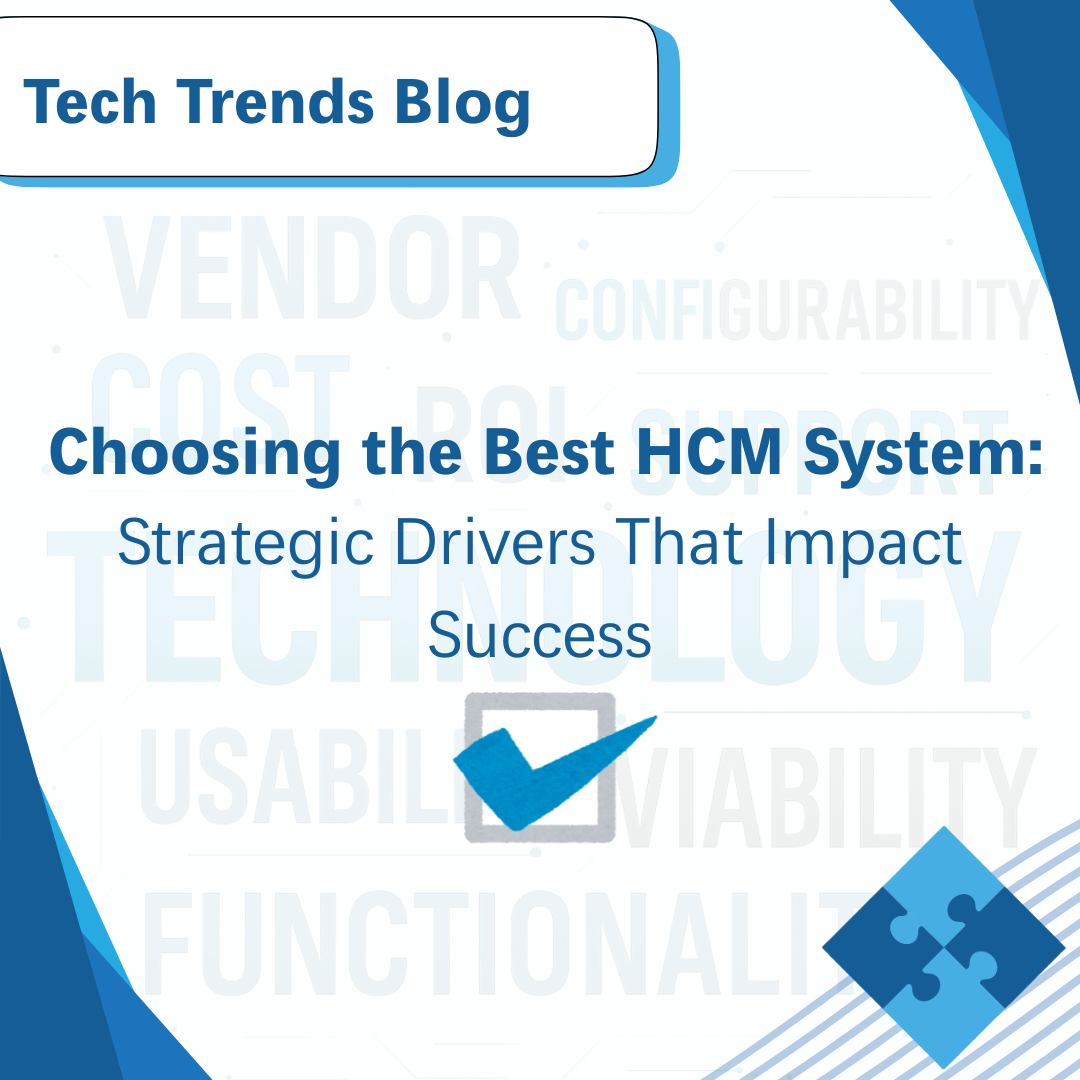
Critical Decision Drivers for HCM Selection
1. Configurability by HR
Modern HR teams need control, not dependence on IT. A configurable HCM allows HR to adjust workflows, approval chains, and business rules directly without requiring coding. The faster HR can make these changes, the more agile your organization becomes, and the fewer bottlenecks slow down compliance or process improvements.
2. Cost and ROI
Price is always part of the equation, but a thorough cost-benefit analysis should also include implementation costs, training plans, integration tasks, and ongoing support. Include all these factors in the return on investment calculation. The right HCM should pay for itself through time savings, data accuracy, and smarter decision-making.
3. Vendor Services
Technology alone does not guarantee success. Implementation support, benefit carrier integrations, training, and ongoing management can significantly impact the success of an HCM implementation. The right vendor should be a strategic partner, not just a software provider, ensuring your system works smoothly long after go-live by considering value-added services.
4. Support
Post-launch support is paramount. How quickly can issues be resolved, and what channels exist for help or escalation? Reliable, responsive support reduces downtime and builds user confidence. Make sure the vendor’s model aligns with your service expectations.
5. Technology
A strong technology foundation matters. Cloud-based architecture, unified databases, and open APIs enable scalability, security, and real-time data. With the right technology, your HCM system grows with your business, eliminating silos and gaps.
6. Usability
Even the most powerful system fails if people don’t use it. Look for a platform that is intuitive, mobile-friendly, and easy to navigate. Usability drives adoption, reduces training time, and encourages self-service. It is not just about what the system can do; it’s about whether people use it.
7. Vendor Viability
A vendor’s stability is critical. Consider financial health, leadership continuity, client retention, and product roadmap. A viable vendor protects your investment and ensures the platform can evolve as your organization grows.
8. Functionality
Functionality ensures the solution meets your current and future needs. From recruiting and payroll to performance and learning, you must evaluate both the depth and breadth of each module. The best systems scale with your organization and adapt as your business evolves.
Working With a Consultant
When you work with an experienced consulting firm like HRchitect to guide you to the right HCM vendor, we assess their viability and functionality upfront. We do not present vendors that fail to meet the minimum standards as options. Knowing the minimum standard will be met allows your team to focus on other key drivers, such as configurability, usability, support, technology, and cost, without worrying about foundational gaps.
Final Thoughts
Choosing the right HCM software solution for your organization is not about the flashiest demo. It’s about finding the right balance of functionality, technology, usability, cost, and partnership. By using decision drivers, you can have confidence that your HCM decision was thoughtful, fact-based, and future-focused, delivering value for your people and your organization.
Let’s talk about what matters most to your organization. Schedule a consultation today to discover how utilizing decision drivers in our targeted evaluation and selection process can help you select the ideal HCM solution, one that drives lasting value.
About the Author

Michelle Peart has over 25 years of experience in human resources and project management. She has a proven track record for developing and implementing new procedures, reducing redundant processes, and implementing efficient systems. She excels in utilizing research, analysis, implementation, and evaluation skills to accomplish individual and team goals. Michelle is customer service-driven and a creative contributor with a knack for researching, troubleshooting, and problem-solving.
Michelle is an outdoor enthusiast who enjoys hiking in the summer and snowshoeing in the winter.
Read more about Michelle on LinkedIn.